Definition
Let n be a non-zero integer, with prime factorization
where u is a unit (i.e., u is 1 or −1), and the pi are primes. Let a be an integer. The Kronecker symbol (a|n) is defined by
For odd pi, the number (a|pi) is simply the usual Legendre symbol. This leaves the case when pi = 2. We define (a|2) by
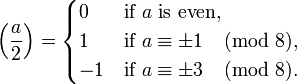
Since it extends the Jacobi symbol, the quantity (a|u) is simply 1 when u = 1. When u = −1, we define it by
Finally, we put
These extensions suffice to define the Kronecker symbol for all integer values n.
Read more about this topic: Kronecker Symbol
Famous quotes containing the word definition:
“It’s a rare parent who can see his or her child clearly and objectively. At a school board meeting I attended . . . the only definition of a gifted child on which everyone in the audience could agree was “mine.””
—Jane Adams (20th century)
“Although there is no universal agreement as to a definition of life, its biological manifestations are generally considered to be organization, metabolism, growth, irritability, adaptation, and reproduction.”
—The Columbia Encyclopedia, Fifth Edition, the first sentence of the article on “life” (based on wording in the First Edition, 1935)
“The very definition of the real becomes: that of which it is possible to give an equivalent reproduction.... The real is not only what can be reproduced, but that which is always already reproduced. The hyperreal.”
—Jean Baudrillard (b. 1929)